Saturday, September 1, 2012

First Fuel Banks

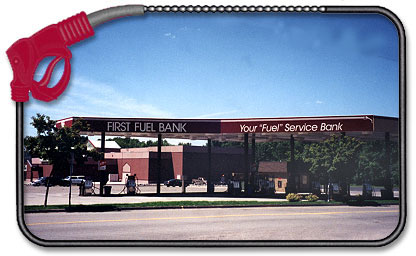
We don't often think of commodity trading as something tangible. Most people trading corn, gold, or oil are trading to make a profit; not to end up with giant stockpiles of corn in their garages. However, I recently stumbled upon First Fuel Banks, a gas station which merges with the commodities market.

Source: First Fuel Bank

With their Prepaid Locked Accounts, customers can purchase gasoline in bulk at a rate based on the current market price. This allows customers to lock in fuel prices. Hypothetically, if someone pre-purchased enough gas, they could potentially be filling their tanks at a rate much lower than gas costs today (in 1992 gas peaked at $1.23 per gallon).

It's rare to see such a clear link between commodity trading and individual consumption. This sort of arrangement has the potential to become much more popular. Who knows, maybe we'll start to see couples buying gold by the ounce to save for future jewelry.

Friday, August 17, 2012

Alcohol in Muslim Countries

It is well known that Muslims don't drink alcohol, as it is haraam (sinful). Many predominantly Muslim countries have even banned alcohol. However, there still is some alcohol consumption in these countries. The Economist looked at alcohol consumption in the Middle East.

Source: The Economist
The number of drinkers varies by country, but some put the total at 5% of those identifying themselves as Muslim. Drinking may even be on the rise. Between 2001 and 2011 sales of alcohol in the Middle East, where Muslims dominate, grew by 72%, against a global average of 30%. That rise is unlikely to be accounted for by non-Muslims and foreigners alone. The black market for spirits flourishes in Libya, while Iranians are adept at producing home brew
Are more Muslims drinking, or are drinking Muslims just drinking more? Is alcohol becoming more accepted in the Middle East? Only time will tell.

Guilty Pleasures

Thanks to Freakonomics for sharing this great quotation from a New York Times book review with Ira Glass.
I don’t believe in guilty pleasures, I only believe in pleasures. People who call reading detective fiction or eating dessert a guilty pleasure make me want to puke. Pedophilia is a pleasure a person should have guilt about. Not chocolate.
We shouldn't be embarrassed about things we enjoy.

Wednesday, August 15, 2012

Unexpected Innovation: The Invisible Bicycle Helmet

Innovation often comes in unexpected places. I plan on making "Unexpected Innovation" a recurring theme on this blog, so expect more posts like this.

The bicycle helmet is clunky, uncomfortable, and unattractive, but also a crucial part of bicycle safety. Starting in middle school, I had absolutely no desire to wear a helmet when I biked. I was a bit nerdy, and didn't want to further my dorky image. I was lucky and never ended up crashing. My brother, on the other hand, fell off his longboard helmet-less and ended up fracturing his skull.

Enter the Invisible Bicycle Helmet. While not invisible, it is essentially an airbag that is worn around the neck which inflates in the event of a crash. It is a much more attractive and comfortable option than the traditional helmet. I'm sure there'd be high demand for it by casual bikers.

Check it out:
http://vimeo.com/43038579


Tuesday, August 14, 2012

Economists for Romney

While I'm still unsure who I will vote for in the upcoming election, it is interesting that over 400 economists have stated their support for Romney on the Economists for Romney site. (Thanks for the tip, Freakonomics). This number isn't very significant, 400 is a tiny number compared to the thousands of economics professors nationwide. It's also hard to quantify since there isn't a competing Economists for Obama site, but still it's interesting to see a large number of economists publicly backing a single candidate.

The statement starts off with:
We enthusiastically endorse Governor Mitt Romney’s economic plan to create jobs and restore economic growth while returning America to its tradition of economic freedom. The plan is based on proven principles: a more contained and less intrusive federal government, a greater reliance on the private sector, a broad expansion of opportunity without government favors for special interests, and respect for the rule of law including the decision-making authority of states and localities.
Here are some of the notable economists who have backed Romney. The list includes five nobel laureates: Gary Becker, Robert Lucas, Robert Mundell, Edward Prescott, and Myron Scholes. Greg Mankiw, a Harvard professor who has written best-selling economics textbooks (his backing of Romeny is not at all surprising, as he is one of Romney's economic advisors). Being a Claremont Colleges student, I want to make note that there are also two Claremont McKenna professors who have signed the statement, Janet Smith and Colin Wright.

Saturday, August 11, 2012

Greece's Economy is Smaller Than Boston's

Source: ThereArePlaces.com

In 2011, Boston's GDP was $326 billion while Greece's was just $299 billion. Pretty astounding when you realize that the European Union and the International Monetary Fund have pledged €240 billion ($291 billion) to keep Greece floating.

Read more at the Atlantic.

U.S. Trade Deficit

We're currently experiencing the lowest trade deficit we've had in 18 months; due to both an increase in exports and a decrease in imports. Our trade deficit was $42.9 billion, down from $48 billion a month earlier. U.S. exports have been strong in most places except for in Europe, which is still in the middle of their debt crisis.

From the Wall Street Journal:

In June, the U.S. notched increases in exports of a variety of goods including pharmaceuticals, cars and industrial engines. Exports increased $1.7 billion to $185 billion, the highest monthly tally ever. Imports declined $3.5 billion to $227.9 billion, driven largely by a drop in oil prices that reduced the value of petroleum imports. Total U.S. exports are up 6% in the first six months of 2012 from the same period a year ago. In the first half of 2011, they were up 16% from the year-earlier period... 
For the U.S., a narrower trade gap would give a considerable lift to the economy at a time when growth has started to sputter, but many analysts were wary of ratcheting up expectations based on the June data. In coming months, a rising dollar, weaker demand in China and the euro zone's woes all are likely to weigh on U.S. trade. Other gauges of exports, such as an index tracked by the Institute for Supply Management, show demand already is slipping.  
 
In short, while this decreased trade deficit gave a slight push to our economy, it is unsustainable. Global demand is weakening.